Friday, September 25, 2015

Thoughts about the Predicting of Christ's Return

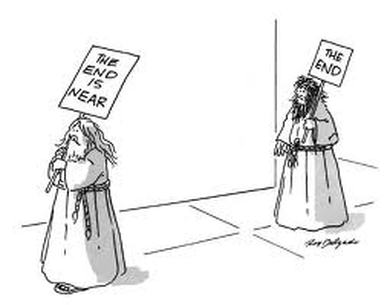
Another prediction of Christ's return, another day where the world does not end. Jesus himself was clear on this point, but his followers have always had a difficult time understanding him in one degree or another.

"But about that day or hour no one knows, not even the angels in heaven, nor the Son, but only the Father." Matthew 24:36

You would think that this would be enough to dissuade Christians from attempting to pin point the exact day of Christ's return or at the very least not take seriously anyone who claimed to have found it. History shows us otherwise and especially since the modern era there have been many false predictions based upon numerology, star charts, blood moons, political maneuverings, popular fiction and unhinged religious leaders. They take some of Jesus' words concerning the end of times and then try to match them with what is going on in the present day. The result has been thousands of false predictions, some of which were mixed with strange ideas and cost people their lives.

Coincidence? Actually yes, I think it is...
The precise date and time of our lord's return is none of our business. He will come when he comes and our task is to be ready, which means cultivating a life of faith and devotion in the present that will last eternity. The Father has decided that none one will know, not even the Son. How then would anyone find out? Did the creator of the universe accidentally leave the answer in a constellation? If he did then how would you go about perceiving it? Will God appear to a doomsday enthusiast like he did to Jacob and be wrestled with until morning? Perhaps the Father will change his mind on the issue and nullify the scripture that says the time will come when nobody expects it like a thief in the night. (1 Thes 5:2) No, this mystery is shut to us and we will not have access to it until after it has happened.

So why do Christians continually announce dates for Jesus' return? I think there are a few reasons. The evangelical culture of America thoroughly embraced the idea of a literal apocalypse which became popularized by End Times preaching, prophecy conventions, and Tim LaHaye's "Left Behind" series. A literal reading of the Bible has also been a pillar of American Evangelicalism and so between these two phenomena there have been widespread acceptance and expectation of what became known as 'The Rapture' where all the Christians would be taken up into heaven (1 Thess 4:16-17) and the tribulations which were to follow. (During a course I took on the Book of Revelation the professor explained that these particular apocalyptic expectations are unique to North America, no other form of Christianity has ever conceived of 'The Rapture', but that is part of another discussion altogether.)

In one respect the Lord's return is supposed to be an encouraging thing (1 Thess 4:18) and the more charismatic among us tend to thrive on the apocalyptic. The majority of End Times hype I see on social media wherein blood moons, wars, and the itinerary of the Pope herald the second coming is enthusiasm taken to the edge of sound doctrine. It is important to be grounded in the Scriptures and sound doctrine or enthusiasm can be mistaken for inspiration and encouraging others by reminding them that the Lord could return very soon can become futile predicting, As for the 'prophetic ministries' that ride the circuit claiming to have identified The Two Witnesses, The Mark of the Beast, Gog and Magog, and the star called Wormwood, they are spiritual snake oil peddlers who should be ignored.

Greg Out.

Sunday, September 20, 2015

Thoughts on Losing our Saltiness (Matthew 5:13)

In Matthew 5:13 Jesus tells his followers, "you are the salt of the earth, but if salt has lost its taste, how shall its saltiness be restored? It is no longer good for anything except to be thrown out and trampled under people's feet."


"You are the salt of the earth..."

This is a popular passage that countless preachers and theologians have taught on. Salt was important in the ancient world because of how it preserved food. Since there were no refrigerators meat would begin to rot unless it was properly salted. In the same way sin makes the world go rotten and the preservative against this are Jesus' followers who would later be empowered by the Holy Spirit as they continually submitted to Christ. The first part of this passage is immensely popular (at least it is in Evangelical preaching) and there is always room to expand this metaphor in light of the rest of Scripture and discern practical applications but my thoughts right now are on the rest of the passage.


"If salt has lost its taste..."

what is Jesus talking about here? Generally speaking salt does not lose its saltiness. You can grind it up, dump it in water, and use it to preserve your food but it will not become any less salty. Scientifically speaking common table salt is a very stable compound (Sodium Chloride [NaCl]). The only way for salt to lose its saltiness is for it to cease to be salt via a chemical reaction which changes it into a different compound.1 We could apply this understanding to Jesus' followers by saying that for them to "lose their saltiness" is for them to cease being Jesus' followers. After all, it is Jesus who provides the "saltiness" necessary to preserve the world from decay through the work of the Holy Spirit as Jesus' followers continue in active faith. This is a nice thought and I believe it's true but it is probably not the exact same truth that Jesus was communicating to the original audience at this time since the Holy Spirit had not arrived yet and nobody had a scientific understanding of the atomic structure of salt.

So what is Jesus talking about then? Most commentaries you pick up will say something along the lines that this is a figure of speech for an ineffective Christianity that is either too watered down by the philosophies of the world or becomes dispirited when called to the difficulties of indignation and persecution. This is the most common explanation but there are difficulties with this reading because persecution of Jesus' followers' would not have been a reality yet, although it is possible that Jesus was preparing them for such.

One explanation that I had not heard before that I think warrants some investigation is the idea that Jesus is talking about the salt in the temple that was for sacrificial use.2  Jesus was a Jew speaking to Jews and the Book of Matthew was written by a Jew specifically for the Jews so it should not come to anyone's surprise that Jesus might be making a distinctively Jewish reference. The implications of this interpretation will be made clear further on as it is this interpretation that I would like to explore.


An aside on exegeting the Scriptures as a Christian.

Here is the amazing thing about interpreting the Scriptures, each of the interpretations above may be different but they are all valid. Tracking down the precise meaning and intention of the text and how the original audience understood it is only the beginning of exegesis. Within Christianity the Holy Spirit relates the meaning of Scripture to the minds and hearts of Christians not necessarily by providing a precise knowledge of original context but rather by relating the intended meaning to the context of the reader. There are always multiple interpretations that arise out of different contexts but if they are truly interpretations that are from the Holy Spirit then they will agree with each other in spirit and be consistent with the rest of Scripture. Let us now continue with idea that Jesus is making a reference to sacrificial salt from the temple.


"how shall its saltiness be restored?"

The universal understanding is that this is a rhetorical question implying that it is an impossibility. Once salt has lost its saltiness it cannot be made salty again. This is an unnatural thing though because salt does not lose its saltiness.3


"It is no longer good for anything..."

Salt's purpose is to preserve and make savoury. If it no longer does these things then what else is it good for? Nothing. As Gill explains,
"Salt is good for nothing, but to make things savoury, and preserve from putrefacation; and when it has lost its savour, it is of no use, neither to men nor beasts, as some things are when corrupted; nor is it of any use to the land, or dunghill, for it makes barren, and not fruitful: so ministers of the word, when they have dropped the savoury doctrines of the Gospel, or have quitted their former seeming savoury and exemplary conversations; as their usefulness is gone, so, generally speaking, it is never retrieved; they are cast out of the churches of Christ, and are treated with contempt by everyone."4
Pastors, Priests, and anyone who claims to be a Christian but falls away from Christ into immorality are indeed treated with contempt by everyone. Priests who molest children, pastors who beat their families, Christians who pass judgement on the world while doing as the world does, they are all (severe) examples of salt that has become useless.


"except to be thrown out and trampled under people's feet."

This is where interpreting the salt as sacrificial salt of the temple makes a difference. The common understanding is that being trampled under people's feet is to be treated with the utmost scorn and contempt. Ellicott picks up a different nuance though in that temple salt that was unfit for sacrifices was spread out on wet surfaces so that the priests would not slip while they walked.5 If this is what Jesus is referring to then unsalty salt actually does have a use, it keeps the priests from falling. Or to put it another way, the fate of Christians who fall away from Christ / become ineffective / sacrifice their witness for sinful indulgence / etc. serve as a warning to other Christians of what will happen if they do the same thing. In seeing the brokenness in the lives of friends and colleagues that have fallen away Christians who learn from the mistakes of others are better equipped and prevented from falling themselves.

This may not be the precise meaning Jesus communicated to the original audience but I think it still has its merit as a reasonable interpretation and a truth that I have encountered in my own life. Allow me to share a personal anecdote.

I remember while in college and seminary I had a number of friends in the college, one of whom continually ignored his responsibilities as a Christian and knew it. Without going into any detail lets just say that he (and everyone around him including non-Christians) knew that he was not a good Christian. By his last semester I couldn't figure out why he was even there since his life was a mess and he seemed determined to not learn anything or change his ways. I had seen every type of loving care extended to him from godly instruction to tough love confrontation to gentle pastoral care but nothing would inspire him to live for Christ. The explanation came from another friend of mine who knew the situation, "maybe he's one of those friends God puts in our lives for us to learn from..." This put his struggles into perspective. He might not get any benefit from being there but the rest of us did by watching the desolation of his godless walk continually unfold. Salt that needed to be thrown out because it had become useless for its intended purpose was being used so that others would be sharpened in fulfilling their intended purposes.

I think this is an intended good that God brings about when we refuse to follow him.

There is still one question that presses for an answer though. If salt that loses its saltiness cannot be made salty again then what happens to Christians who fall away from Christ? Are we to conclude that Christians who lose their witness or fall away from Christ are without hope?

No. Salt that is no longer salt cannot become salt again of its own will but God is able to do the impossible. The warning is strict and the illustration is vivid but I don't think Jesus is talking about simply lapsing into sin or losing salvation because you made a mistake. Christian faith is founded upon God's grace which is instantly and abundantly available to any who repent of their sins. This isn't a "if you mess up you'll be thrown out of the Kingdom and not allowed back in," rather it is "if you completely turn your back on Jesus and wallow gleefully in your sin knowing full well that it is evil and enjoying it anyway without remorse or repentance."

I think there are times when a Christian loses his saltiness, so to speak, when his sins wreck his witness and even after repentance and forgiveness he must live with the consequences. A pastor who is caught in a scandal or abuse is not fit for ministry and so his participation in the Kingdom is restricted.

Thoughts? Comments? Please write them below.

Greg Out.


_______________________________________________________
  1. Deneen White, "How does Salt Lose its Saltiness?" on i was MADE for this, (Blog) 6 January 2007, http://deneenwhite.com/2007/01/06/how-does-salt-lose-its-saltiness/
  2. Charles J. Ellicott, "Ellicott's Commentary for English Readers," on Bible Hub, (website) http://biblehub.com/commentaries/ellicott/matthew/5.htm.
  3. John Gill, "Gill's Exposition of the Entire Bible." on Bible Hub, (website) http://biblehub.com/commentaries/gill/matthew/5.htm.
  4. John Gill, "Gill's Exposition of the Entire Bible." on Bible Hub, (website) http://biblehub.com/commentaries/gill/matthew/5.htm.
  5. Charles J. Ellicott, "Ellicott's Commentary for English Readers," on Bible Hub, (website) http://biblehub.com/commentaries/ellicott/matthew/5.htm.

Wednesday, September 16, 2015

A Theology of Web Design

Web Design for me has dual theological points. The first is a theological understanding of myself as a web designer and the second is a theological understanding of web design in relation to the Church.

For myself I have been given abilities, opportunities, and resources from The Lord to use for the benefit of his Kingdom. I picture myself as one of the servants in Jesus' parable of the Talents (Matt 25:14-30). One of my abilities, or talents if you like, is a comprehension of computers to make web sites. As of writing this post it maybe isn't my most developed or invested talent but it is one that I am developing and will continue to develop over time so that I will have something to show for the talent the master has given me by hopefully bringing him double like one of the good servants. (I imagine myself as being the servant that started with 2).

What this means in plain practical speech is that I have an obligation to serve the Church to the best of my ability by offering my services as a web designer either at a sizeable discount or as a volunteer according to what the church can reasonably afford. On this point I believe that the worker is worth his wages (1 Tim 5:18) but also that I am to do all things as unto the Lord (Col 3:23). So I am willing to work for a discount rate of $20 per hour (instead of $42 per hour) if a church or Christian nonprofit organization is large enough to field the wages while also being open to creating a website for free if the church is unable to pay me. ( I have already redone two church websites free of charge.) I seek to bolster the Kingdom where it needs to be bolstered according to my talents.

For the Church I believe it is imperative that she leverage all of the media resources at her disposal in her mission to build the Kingdom in the name of Jesus for the glory of the Father, by the power of the Holy Spirit. A good website is the base of an online presence in an online world and these days the local church cannot afford to overlook their online presence. I am thinking specifically of Paul's ministry of becoming all things to all people in order to win some (1 Cor 9:19-23) and how an entire generation practically lives and breathes the online world. Nearly every young person surfs the internet and most look up information with a simple Google search on their phone. If a church doesn't have a website then they're invisible to this entire demographic. If a church has a bad or out of date website then they are presenting themselves poorly to a large demographic.

What I see is a disconnect between a lot of churches and their websites. They want young people to feel welcome and hopefully join their congregation but they have no presence where the young people are. These people don't just wander into churches, they look them up online before going in. The website is just the beginning though. Social media like Facebook, Twitter, and Tumblr are primary communication nodes for many young people. If the Church wants to reach these people then they need to meet them where they are and they are online via social media. This has become normal for young people but it is increasingly becoming normal for all people as fingertip online technology is continually growing, becoming more accessible, and integrating with North American culture.

What I offer to hopefully update churches is the creation of mobile friendly, social media integrated and easy to maintain websites that extend the missions of local churches to the online world and look good in the process. In this way I seek to use my talents in the service of the Lord.

Tuesday, September 8, 2015

On the Road to Emmaus

I have been asked by a pastor to lead a night at Bible study and the passage being covered is Luke 24:13-35 which most modern translations have dubbed "On the Road to Emmaus." It's a story unique to Luke among the Gospels and one of my favorite passages. The story is about two people who had followed Jesus and were present during his execution. They are walking home from Jerusalem stunned and grieving what they had witnessed when they encounter Jesus on the road but don't recognize him. He asks them what they are talking about and they ask him if he is the only one visiting Jerusalem who didn't know what had happened. They then explain how Jesus was a prophet of God and how they thought he was the Messiah but that he was murdered by the rulers and now all their hope had come to nothing. Jesus walks with them and teaches them from Moses and the Prophets that the Messiah must suffer and die before entering his glory and explains how the Torah pointed to himself. By dusk they had made it to the home of the two men who invite Jesus to stay with them. As he gives thanks and breaks bread they recognize that it's been Jesus all along and then he vanishes. They then run all the way back to Jerusalem to find Jesus' disciples to tell them that they had seen him...


I like this passage for so many reasons. First of all it's really funny. Here are these two guys that walk with Jesus all day long talking to him about himself but not recognizing him. Was Jesus playing a joke? Testing out his new resurrection powers? Were their faces just continually downcast with sorrow that they never actually took a close look at his face? And then once they recognize him they immediately travel all the way back to Jerusalem after urging Jesus to stay with them because it was too dark to travel. This passage is funny and intentionally so.

Secondly I like this passage because Cleopas (the one who explains his understanding of Jesus to Jesus) embodies the hopes of the reader and, from his perspective, Jesus lost big time and now his hope is crushed. He says with is face still downcast,

"he was a prophet, powerful in word and deed before God and all the people. The chief priests and our rulers handed him over to be sentenced to death, and they crucified him; but we had hoped that he was the one who was going to redeem Israel. And what is more, it is the third day since all this took place."

From the perspective of Cleopas and every other one of Jesus' followers, it looked like this was the end and you can taste the pain in these words. They had trusted in Jesus and he had let them down. But what is more, they are also confused and don't know what to make of other things they have heard about Jesus after his death, He goes on to say,

"in addition, some of our women amazed us. They went to the tomb early this morning but didn’t find his body. They came and told us that they had seen a vision of angels, who said he was alive. Then some of our companions went to the tomb and found it just as the women had said, but they did not see Jesus."

So here they are; hurt, confused, feeling utterly alone, walking home with Jesus and not recognizing him. The reader is expecting the punch line when they finally clue in to who they've been hanging out with this whole time and Luke drags it out by having Jesus explain himself and the necessity of his death to them and they still don't recognize him. Finally, as Jesus prays over the food and breaks bread with them do they realize who it is and Jesus vanishes.

The effect of this encounter is evident.

They asked each other, “Were not our hearts burning within us while he talked with us on the road and opened the Scriptures to us?”

They got up and returned at once to Jerusalem. There they found the Eleven and those with them, assembled together and saying, “It is true! The Lord has risen and has appeared to Simon.” Then the two told what had happened on the way, and how Jesus was recognized by them when he broke the bread.

Then a verse later Jesus appears to all of them and they receive Luke's version of the Great Commission. But wow, the absolute joy and amazement in these passages. Cleopas, and by extension, the reader, is taken through the pain, sorrow, and confusion of what looks like defeat which is transformed to the absolute joy and amazement at God's victory!

This is a pattern in the way God works. He often takes to places where we think that we or God's work are in defeat, and by the world's standards it's a very decisive and evident defeat, but God uses that defeat to bring about his victory. This is the pattern of the prophets who were forerunners to Jesus, Jesus who is the template by which God brings life and victory through death and defeat, and all who have followed him. Glory through the way of pain, a divine riddle, God choosing the weak things of the world to shame the strong and the foolish things of the world to shame the wise (1 Cor 1:28).

This passage gives me hope that the pain and suffering I encounter is not just redeemable but will be redeemed and vindicated because Christ was redeemed and vindicated, the template of glory that all f those who put their faith in Jesus be conformed to.


One last reason why I like this passage. It links the Old Testament to the New Testament.

He said to them, “How foolish you are, and how slow to believe all that the prophets have spoken! Did not the Messiah have to suffer these things and then enter his glory?” And beginning with Moses and all the Prophets, he explained to them what was said in all the Scriptures concerning himself.

I really wish that Luke had maybe written a full account of Jesus exact words in how Moses and all the Prophets specifically pointed to himself. Sometimes I have difficulty seeing how all the Scriptures are related to Jesus but maybe that's not the point. What we have hear is an invitation to search the Old Testament to see how it relates to Jesus. To a Messianic Jewish Rabbi the entire Torah points to Jesus in big fiery banners that light up the sky and an unmistakable voice. To me this shows God's faithfulness and the greatness of his plan for salvation, that it was always something he was building up to and that his interactions with us in this world evidence that. Ever since that fateful journey to Emmaus the Church has looked back to the Scriptures and have explored them as they were meant to be, in relation to Jesus the God's Savior of Mankind.

Monday, September 7, 2015

The World is not Getting Worse

One of the things I constantly hear from other conservative leaning Christians is that the world is getting worse and it's quite possibly worse now than it ever has been and "oh but surely these are the end times." There's a Syrian refugee crisis, ISIS is beheading Christians in the Middle East, North America has forsaken God, Israel is about to be destroyed, terrorists have nuclear missiles, young people love sex and violence, the economy is about to collapse, Gays are marrying, and Miley Cyrus twerked on national television. It's just an indisputable fact that they all inherently know; the world is getting worse.


But it's not.

The world is not getting worse. It is really bad in some places and I want to fully acknowledge the very real suffering inflicted upon many but the world is not nearly as bad as we conservative Christians make it out to be. Yes, terrorism and wars are horrible, famine and plague kill millions, Israel is indeed surrounded, and we have indeed moved away from Christian morals in the west but a brief look at history will show us that, despite all of these things, the world is doing comparatively well.

Don't believe me? Let me ask you, are things really worse now than they were when the pagan emperors of Rome openly persecuted the early Church by shutting down businesses, looting homes, and murdering Christians in the streets (crucifixion and human torch style) and arena to the tumultuous cheers of the rest of the known world? Are things really as bad now as they were when Rome, after being transformed into the locus of Christianity and moral civilization, fell? Are things really as bad today as they were during the invasions of the Muslims, Mongols, and Huns or the Black Death that ravaged entire continents? Is the world really more precarious now than it was doing the Hundred Years War when Christians openly fought and killed each other? Are we really in more dire straights than during the The Civil War, the World Wars, and the Cold War when a palpable dread hung over every nation that the entire world might be consumed by fire and blood? I stamp my foot in defiance and say "no!"

Things are pretty good today when compared to the rest of our history. War is still terrible but it is isolated and there are counter measures and alliances in place to ensure that it doesn't get out of hand. We don't have to fear the Black Plague or Polio or any of the diseases that used to kill entire families and lay waste to cities. Persecution of Christians still exists in different parts of the world but not to the extent or approval of what the early Church suffered at the hands of Nero, Domitian, Trajan, Diocletian and others. The world as a global whole has become safer, kinder, healthier, more Christian (nearly everywhere outside North America) and more cozy today than its ever been before. So I ask by what metric is it worse?

The world is not teetering on the edge of self-destruction, the evils we see and hear about are the same evils that have always been with us. Human kind, apart from Christ, is morally destitute and that will always manifest in immoral behavior and anti-Christian philosophies that each generation of the Church has to deal with in their time. The world and the forces of the world are the same as they have ever been; fallen and rebellious but ultimately subservient to King Jesus. The devil has been defeated and no power or authority exists unless it be under Christ so what's all the fuss about?

Why do we believe that the world is getting worse? There are a few reasons. We are more aware of what is going on in the world due to communication technology (TV, Internet, Newspapers). Our North American culture thrives on sensationalism which brings 'sensational things' to the forefront of every media outlet. Various denominations within Evangelical Christianity lean towards an over-realized eschatology where it is cool to predict the end times and the widespread death and devastation after The Rapture as predicted in a literal reading of Revelation is cause for excitement and celebration. The older generations have a difficult time processing the rapid change and information overload that has only been getting faster and bigger every year. The biggest factor though probably the cultural shift away from Constantinian Christendom into Humanist Secularism. When conservative Christians firmly believe that the world is getting worse I think what we really mean is that North American culture no longer recognizes the Bible understood by Christian principles to be an authority to live by. In the past this has lead to a culture of fear, specifically in the United States, and moral panic that brought about the prohibition, a crackdown on creative license, literal witch hunts, and blaming popular entertainment (from movies to tabletop to video games) as morally corrupting our youth, encouraging Satanism, and, among other things, bringing about the immanent apocalypse.

I don't like this sort of pious perturbedness because it leads to a stunted spirituality. It often misses the mark by passing judgement upon the world, passing false judgement upon ourselves, fear mongering, and using up energy and resources where they are spent in vain.

Passing Judgment upon the World

As Christians we are not supposed to judge the world, that is God's business, we are to judge each other in love in order that we may know Christ more fully. (1 Cor 5:9-13) That the world is corrupt is no reason to be upset because the world has been corrupt since humankind ate the forbidden fruit in the garden of Eden and will continue to be corrupt until Christ reforms it anew. To lament the state of the world is to share in God's heart, to be weary of the world is part of your citizenship in God's kingdom, but to judge the world is to act in the place of God which neither you nor I were not created for.

Passing False Judgement upon Ourselves

When we spend time grumbling among each other about how bad the world is and how evil the days are it becomes easy to forget that we also do bad things and are sinful. We can fall into feeling morally superior in a feigned holy helplessness and the root of pride is nourished by our watering it. In a strange spiritual paradox it is possible that in despising the world one becomes more worldly and looks to his own self righteousness instead of Christ's righteousness imputed to you. In this way being piously perturbed can lead falsely judging ourselves.

Fear Mongering

The Kingdom of God is built not built upon fear, but when we become obsessed with pronouncing evil the world is we are often trying to bolster the Kingdom through fear tactics. There is a godly fear which is vital to faith and is brought about as a conviction of the Holy Spirit but there is also plenty of common fear which, even though it may be steeped in Biblical language, is just fear mongering. What benefit is there in getting everyone all worked up about how you believe we're all going to Hell in a hand basket? This sort of fear spreading is inappropriate for a Christian because "God has not given us a spirit of fear but of power and love and a sound mind," (2 Tim 1:7). It damages a brother or sister's soul to be in fear of the world. The natural growth of a Christian is towards Christ in faith but fear distracts and redirects growth away from Christ. Fear tactics do not work in God's Kingdom because fear tactics are of this world and God's Kingdom is not of this world. It is by faith in Christ that we overcome trials and fears because Christ is the one who has overcome the world. So there is a better way of dealing with the evils of the world, it is to walk humbly with your God, casting all your fears upon him because he cares for you, and in every situation, by prayer and petition and thanksgiving, present your requests to God. (John 16:33; Micah 6:8 1 Peter 5:7; Phil 4:6)

Resources Spent in Vain

Much ink, breath, sweat, blood, and tears have been spent upon trying to legislate morality or spread the word about whatever new travesty threatened Christian society. Even if these methods were effective (and they are not) those who are piously perturbed would never be satisfied because as soon as one travesty has been abolished three more take its place. For the complainer there is always something to complain about, even if there is really nothing to complain about. The sort of pious perterbedness I am writing about works the same way. It is not possible to remove the darkness by attempting to stomp on it or point a finger at it or shovel it out one bucket at a time. We have been called into God's work of being the light of the world and it is only in living by faith in Christ that this light shines.


So in conclusion let all Christians look to Christ in humble faith not fearing the world though it be fearsome. The world and all that is in it are subject to Christ. He allows some things to happen and forbids others. Things will never get out of control because he is in control of all things. What is more, though God be almighty and transcendent he is available, nay, imminently involved in the lives of his people, from the life and death scenarios around the world to the common and mundane things.

Thoughts? Please voice them in the comments below.

Greg Out.